
ADVERTISEMENT
Why Were No Bodies Found in the Wreck of the Titanic?
The story of the RMS Titanic is one of history’s most infamous maritime disasters. When the “unsinkable” ship struck an iceberg on the night of April 14, 1912, over 1,500 lives were lost. The tragedy has fascinated historians, filmmakers, and curious minds for more than a century. Yet, amid the countless investigations and explorations of the Titanic wreck, a striking fact emerges: no human bodies have ever been found at the wreck site on the ocean floor.
This absence raises questions, fears, and even conspiracy theories. How could more than a thousand people perish, yet not a single body remains at the bottom of the North Atlantic? In this blog post, we will explore the historical, environmental, and scientific reasons behind this puzzling phenomenon. We’ll also discuss what happened to the victims’ remains, the role of the deep-sea environment, and the discoveries that have shaped our understanding of the Titanic tragedy.
The Immediate Aftermath of the Titanic Sinking
Before examining the wreck itself, it’s important to understand what happened the night the Titanic sank.
On April 14, 1912, the Titanic collided with an iceberg at around 11:40 p.m. Despite the ship’s sophisticated safety features for the time, it sank in less than three hours, around 2:20 a.m. on April 15. The frigid waters of the North Atlantic, averaging 28°F (-2°C), were immediately lethal for most passengers who ended up in the water.
Out of the estimated 2,224 people on board, approximately 710 survived. Rescue efforts were limited by the size of nearby ships and the lack of immediate communication. As a result, hundreds of people went into the water, many of whom perished almost instantly due to hypothermia.
Why Bodies Weren’t Recovered Immediately
- Water Temperature: The extreme cold caused rapid hypothermia. Victims’ bodies were also subject to the “cold shock” effect, which can make drowning deaths extremely quick and violent.
- Limited Recovery Operations: Only 20th-century ships had the capacity to reach remote areas. Immediately after the disaster, the recovery ships (such as the CS Mackay-Bennett) could only retrieve bodies floating on the surface or near ice fields. Many bodies sank before they could be recovered.
- Survivor Testimonies: Survivors reported bodies sinking quickly after the ship went down, making surface recovery impossible for the majority.
This explains why relatively few bodies were ever found at sea, but what about the wreck itself—more than 12,000 feet (3,700 meters) below the surface?
The Titanic Wreck: A Harsh Deep-Sea Environment
The Titanic was discovered in 1985, lying approximately 12,500 feet below the ocean’s surface, about 370 miles off the coast of Newfoundland. The wreck sits in one of the most extreme environments on Earth, where conditions are inhospitable to human remains.
Factors That Prevent the Preservation of Bodies
- Extreme Pressure: At the wreck site, water pressure exceeds 6,000 pounds per square inch. Human bodies cannot withstand this pressure for extended periods. Any organic material, including bones, would gradually break down under such stress.
- Near-Freezing Temperatures: The water temperature near the seabed is around 28°F (-2°C). While cold water can slow decomposition, it does not prevent it entirely over the course of decades, especially under crushing pressure.
- Scavenging Creatures: The deep-sea ecosystem includes scavengers such as amphipods, hagfish, and other specialized organisms that feed on decaying organic matter. Reports from submersible expeditions note that hagfish and amphipods have consumed most organic material on the wreck, including wood, leather, and fabric from the ship itself. Human bodies would have been prime targets for these scavengers.
- Time Factor: Over 110 years have passed since the sinking. Even in less extreme environments, human remains are not indestructible. In the ocean, bones and tissues gradually disintegrate due to microbial action, chemical reactions, and mechanical erosion from currents and sediments.
Bodies Recovered After the Sinking
While no bodies were found at the wreck, some victims were recovered from the water in the days following the disaster.
- CS Mackay-Bennett recovered 306 bodies, including those of first-class passengers.
- Other ships recovered smaller numbers of bodies, but the vast majority of victims were never found.
- Recovery teams reported that many bodies were missing limbs, had clothes stripped by water and ice, or had been partially eaten by marine animals.
The low recovery rate on the surface helps explain why none were found in the wreck itself: most bodies sank into the deep, inaccessible waters and were quickly consumed or decayed.
The Role of Ocean Currents and the Sea Floor
Another critical factor is the dynamic nature of the ocean floor. The Titanic rests on a muddy, sediment-heavy seabed in the North Atlantic.
- Currents: The North Atlantic Drift moves sediments and objects over time, burying debris and eroding structures. Organic material like human remains can be carried away or buried in sediment layers, making them invisible to explorers.
- Submersion of the Ship: The Titanic broke into two main sections, scattered across the ocean floor. Bodies that sank might have been trapped in debris, under steel beams, or inside compartments that collapsed, making them inaccessible.
Scientific Explanations: Why Decomposition Was Accelerated
While cold water slows bacterial activity, the deep sea has specialized microbes that thrive under high pressure and low temperatures. These microbes accelerate decomposition in ways that differ from surface waters.
- Anaerobic bacteria consume tissues in oxygen-poor environments, producing gases and acids that break down bones and soft tissue.
- Chemical erosion: The interaction of seawater with minerals from the ship’s wreckage also contributes to the breakdown of organic matter.
In short, any bodies that reached the ocean floor would have been rapidly decomposed or eaten over the decades, leaving little to no trace.
Myth-Busting: Common Misconceptions
Several myths circulate about why no bodies were found at the wreck site:
- Bodies Were “Removed” by Salvage Operations: Some conspiracy theories claim that bodies were secretly taken by treasure hunters or government agencies. There’s no evidence to support this; salvage operations focus on the ship and artifacts, not human remains.
- Bodies Are “Preserved” in the Wreck: Some imagine the Titanic as a frozen time capsule. In reality, the deep sea is far from static. Currents, scavengers, and chemical reactions prevent the long-term preservation of bodies.
- Bodies Were Vaporized or Dissolved Instantly: While decomposition occurs, human tissue does not vanish instantly. It takes decades for soft tissue and even bones to degrade in the deep sea.
Comparing to Other Shipwrecks
Interestingly, the Titanic is not unique in this regard. Other deep-sea shipwrecks show similar results:
- The Lusitania (sunk in 1915) and other wrecks below 3,000 meters often yield no human remains.
- Shallow-water wrecks tend to preserve bodies better due to less pressure and reduced scavenger activity.
This comparison reinforces that the lack of bodies at the Titanic is a natural consequence of its depth and the ocean environment.
What Remains of the Titanic Today?
Exploration of the Titanic wreck has revealed:
- Artifacts: Dishes, shoes, suitcases, musical instruments, and pieces of luggage.
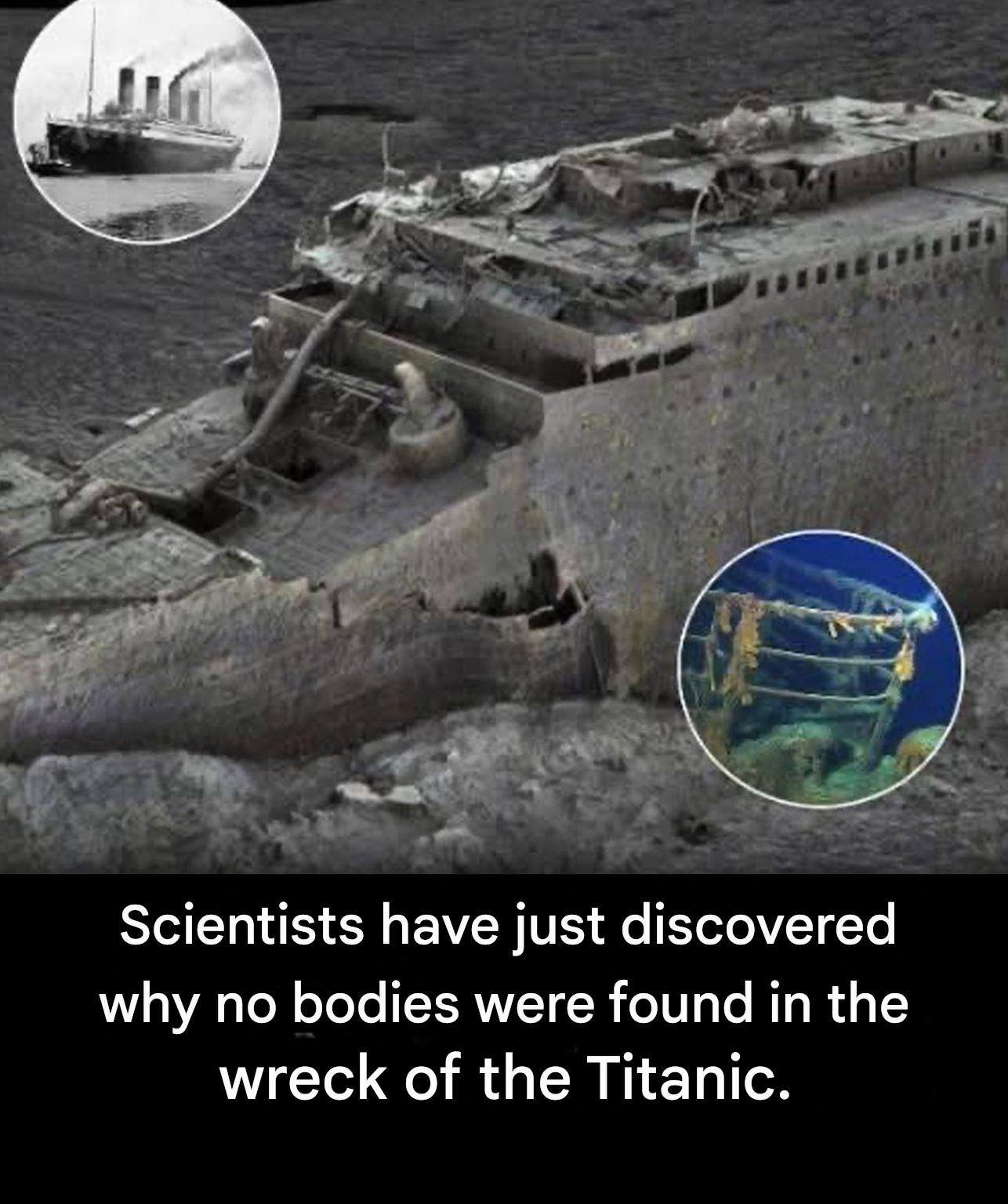
- Ship Structure: The bow and stern are largely intact, though heavily corroded.
- Decay: The ship is slowly being consumed by iron-eating bacteria, reducing steel structures to rust “flowers.”
Despite the extensive exploration, human remains have never been found, supporting the theory that the deep-sea environment destroyed or scattered any bodies that sank with the ship.
Psychological and Cultural Impact
The absence of bodies adds a haunting dimension to the Titanic tragedy. Unlike other disasters, there is no grave at the site—only a ship resting in darkness, miles beneath the ocean.
- For families: The lack of physical remains meant many victims have no burial site, making closure difficult.
- For popular culture: Films, books, and documentaries emphasize the mysterious emptiness of the wreck, enhancing the Titanic’s legendary status.
The idea that the bodies “disappeared” in the deep sea has fueled both fascination and fear for over a century.
Modern Technology and the Search for Remains
Advances in deep-sea technology have made it possible to explore the Titanic in unprecedented detail. Submersibles like Alvin, remotely operated vehicles (ROVs), and sonar mapping have photographed and mapped the wreck.
- ROVs can reach the wreck but have not found any human remains.
- High-resolution imaging shows artifacts and ship decay but confirms the absence of bodies.
Even with modern technology, the conditions of the deep sea make the discovery of bodies virtually impossible.
For Complete Cooking STEPS Please Head On Over To Next Page Or Open button (>) and don’t forget to SHARE with your Facebook friends
ADVERTISEMENT
