
ADVERTISEMENT
The Orchid’s Secret: Strong Roots and Abundant Flowers (That No One Thinks About)
When people think of orchids, they think of beauty.
They think of elegant petals arranged like living sculptures. They think of rare colors—violet, ivory, gold, speckled pink. They think of something fragile, something luxurious, something that belongs on a windowsill or in a carefully wrapped gift.
What they rarely think about is the roots.
Hidden beneath the potting bark, clinging to trees in tropical forests, or winding themselves into unlikely spaces, orchid roots are strong, stubborn, intelligent, and essential. Without them, there are no flowers. Without them, the orchid does not survive. Yet almost no one talks about them.
This blog post is about orchids—but not in the way they’re usually discussed. It’s about what supports beauty. It’s about strength that isn’t decorative. It’s about growth that happens quietly, out of sight, long before anything blooms.
Orchids: A Brief Misunderstanding
Orchids have a reputation for being difficult.
People say they’re fussy. Temperamental. High-maintenance. They’re treated like exotic divas of the plant world—plants you admire from a distance but hesitate to care for yourself.
And yet, orchids are among the largest and most adaptable plant families on Earth. They grow in rainforests, deserts, mountains, and even near the Arctic Circle. Some orchids live in soil, others cling to rocks, and many grow suspended in air.
What’s fragile about that?
The misunderstanding comes from focusing only on the flowers. Flowers are temporary. They are the orchid’s announcement, not its foundation. When the bloom fades, people assume the plant is failing. In reality, the orchid is often just returning to the work that matters most: strengthening its roots.
The Architecture of Orchid Roots
Unlike the roots of many houseplants, orchid roots are not designed primarily to dig into soil.
Most commonly grown orchids—like Phalaenopsis—are epiphytes. In nature, they grow attached to trees, not parasitically, but cooperatively. Their roots wrap around bark, grip surfaces, and absorb moisture from the air.
These roots are covered in a spongy tissue called velamen. Velamen acts like a sponge and a shield:
It absorbs water quickly when rain or humidity is available
It protects the root from drying out
It allows gas exchange
It reflects excess light
This structure alone tells a story of resilience. Orchid roots are built for inconsistency. They are designed for environments where water comes and goes, where stability is not guaranteed.
In other words, they are built for survival—not comfort.
Strength That Doesn’t Look Strong
Orchid roots don’t look impressive in the way we expect strength to look.
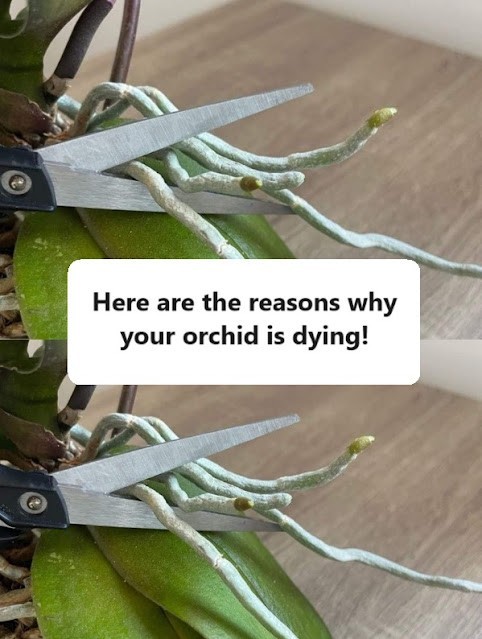
They’re pale. Sometimes silvery. Sometimes green. They twist and wander. They grow above the pot, outside the pot, anywhere they can.
To an untrained eye, they look messy.
Many new orchid owners panic when they see roots growing out of the pot. They think something is wrong. They try to tuck them back in, cut them off, or repot unnecessarily.
But those wandering roots are signs of health.
Orchids do not confine themselves politely to the containers we give them. Their roots explore. They reach. They adapt. They refuse to stay hidden if hiding is not beneficial.
This is a kind of strength we don’t often celebrate: the strength to grow openly, awkwardly, without concern for aesthetics.
Flowers Are the Result, Not the Goal
The most common mistake people make with orchids is focusing exclusively on blooms.
“How do I make it flower again?”
“Why isn’t it blooming?”
“Should I throw it away if the flowers fall?”
These questions reveal how disconnected we are from the plant’s actual life cycle.
An orchid blooms when it has stored enough energy. That energy comes from healthy leaves and, more importantly, healthy roots. Roots absorb water and nutrients. They support photosynthesis. They regulate growth.
When an orchid is working on its roots, it is investing in its future.
No one applauds that phase. There are no bright colors, no dramatic displays. Just slow, patient expansion beneath the surface.
And yet, without that invisible work, the flowers never come.
The Long Silence Before Blooming
Some orchids take years to bloom.
In the wild, an orchid seed can take anywhere from five to ten years to produce its first flower. During that time, it develops relationships with fungi, strengthens its root system, and learns its environment.
Imagine that: years of growth with nothing to show for it—at least nothing visible.
In a culture obsessed with quick results, orchids remind us that timing matters. Blooming too early can be fatal. Blooming without a foundation leads to collapse.
The orchid waits until it’s ready.
Not when it’s pressured.
Not when it’s compared.
Not when someone else decides it should be flowering by now.
Strong Roots Allow Abundant Flowers
When an orchid does bloom well—multiple spikes, long-lasting flowers, vibrant color—it is never an accident.
It is the result of:
Consistent care
Stable conditions
Strong, undamaged roots
Time
A weak-rooted orchid might still produce flowers, but they will be fewer, smaller, and shorter-lived. Over time, the plant exhausts itself.
Strong roots allow generosity. They allow abundance. They allow beauty that doesn’t come at the cost of survival.
This is a lesson worth remembering beyond gardening.
What No One Thinks About When Admiring Orchids
When someone compliments an orchid, they say things like:
“It’s so pretty.”
“I could never keep one alive.”
“You’re so lucky it’s blooming.”
No one says:
“You must have taken good care of the roots.”
“That plant must feel stable.”
“A lot of unseen work went into this.”
And yet, that is the truth.
We are trained to notice outcomes, not processes. We admire results without considering the quiet labor beneath them.
The orchid does not mind. It blooms anyway.
Root Health Is Emotional Health (Yes, Really)
Orchid roots are sensitive. They respond quickly to overwatering, rot, suffocation, and neglect. They need air as much as they need moisture.
Too much care can be as damaging as too little.
This balance mirrors something deeply human: growth requires both support and space.
Roots that are constantly soaked rot.
Roots that are completely ignored shrivel.
Roots that are allowed to breathe thrive.
The healthiest orchids are not the ones fussed over daily, but the ones whose basic needs are met consistently and respectfully.
Orchids Teach Us Patience
There is nothing fast about orchid care.
You water.
You wait.
You observe.
You adjust.
Sometimes nothing seems to happen for months. No new leaves. No spikes. Just quiet existence.
And then, one day, a small green nub appears at the base of the plant.
A flower spike.
It doesn’t announce itself loudly. It doesn’t rush. It grows millimeter by millimeter, bending toward light, forming buds slowly, deliberately.
By the time the flowers open, the work has already been done.
Why Root Work Is Invisible—and Why That Matters
Roots are hidden by design.
They work underground, inside bark, beneath surfaces. They are not meant to be admired. They are meant to function.
For Complete Cooking STEPS Please Head On Over To Next Page Or Open button (>) and don’t forget to SHARE with your Facebook friends
ADVERTISEMENT
