
ADVERTISEMENT
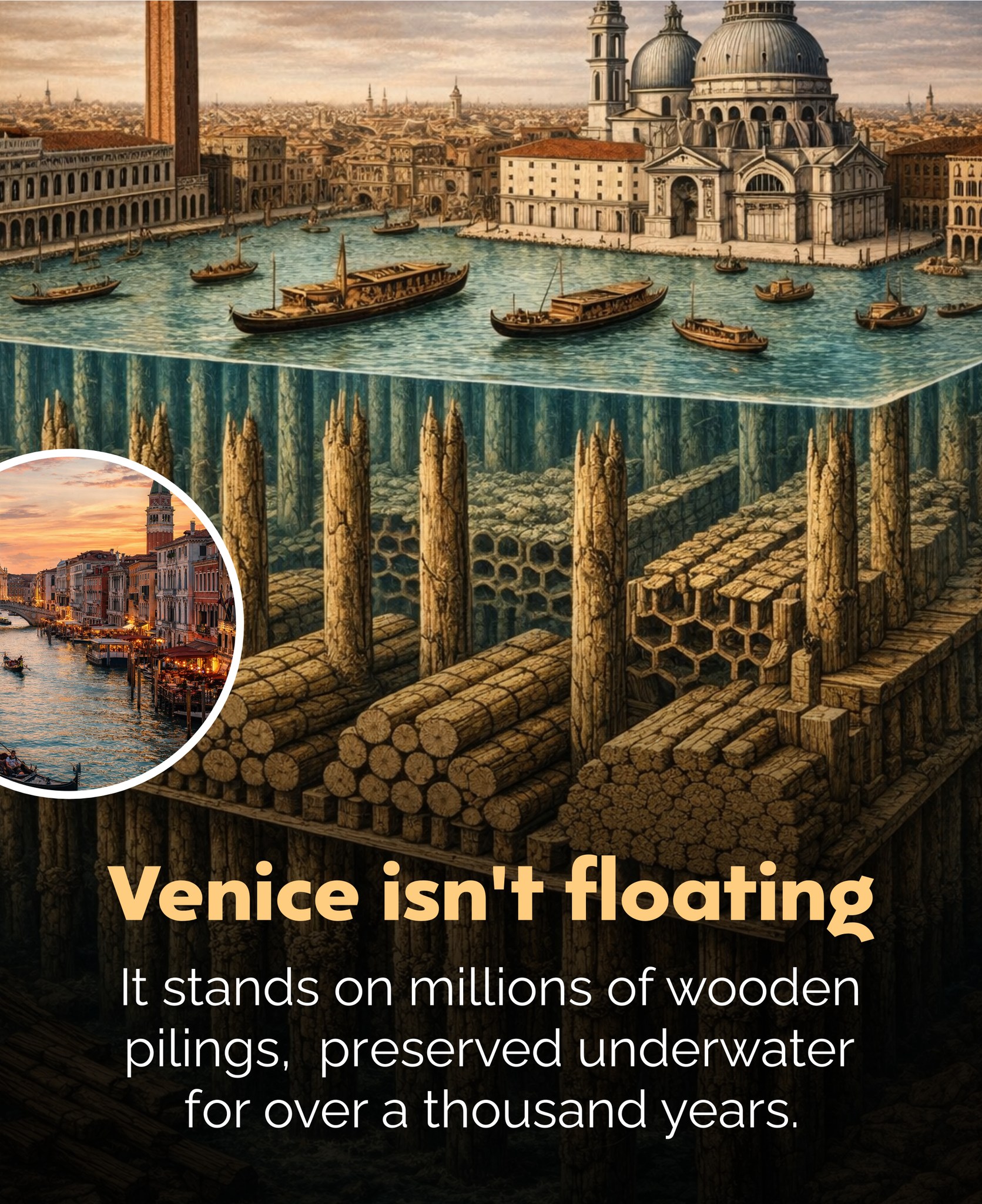
On top of these piles, builders placed:
Wooden planks laid horizontally
A layer of stone (often limestone)
Brick and mortar foundations
The visible stone buildings above
What appears to be a palace resting directly on water is actually standing on a carefully engineered platform hidden below the surface.
Why the Wood Didn’t Rot
Here is where Venice becomes truly extraordinary.
Normally, wood submerged in water would rot. Microorganisms, fungi, and oxygen break down organic material over time. Yet Venice’s wooden foundations have survived for centuries.
The reason lies in the lagoon’s environment.
The piles are submerged in oxygen-poor (anaerobic) conditions. Without oxygen, the bacteria that cause decay cannot survive. Instead of rotting, the wood slowly mineralizes, becoming harder over time.
In some cases, the wood has turned almost stone-like.
This means Venice is not standing on decaying supports—it is standing on a petrified underwater forest.
Where Did All the Wood Come From?
Venice itself had no forests. Its builders sourced timber from across northern Italy and the Adriatic region.
Key sources included:
The forests of the Alps
Regions in modern-day Slovenia and Croatia
The Po River basin
Oak, larch, elm, and pine were commonly used. These trees were cut, transported by river and sea, and driven into the lagoon floor by hand using massive wooden hammers.
The scale of this operation is staggering.
Entire forests were harvested to support Venice’s growth. Some historians estimate that millions of trees lie beneath the city.
Venice’s maritime empire was built not only on ships and trade—but on timber hidden underwater.
ADVERTISEMENT
