
ADVERTISEMENT
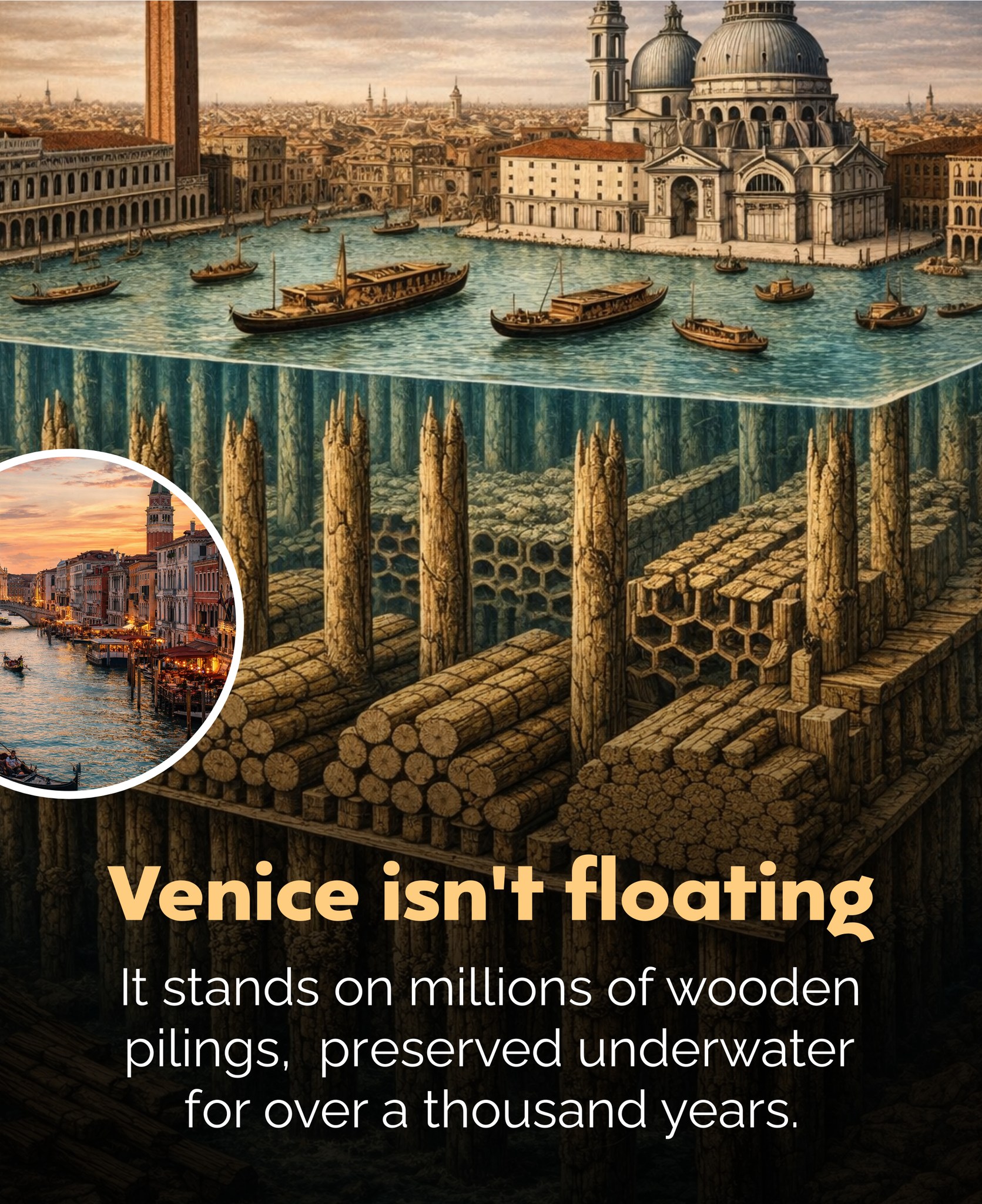
Venice stands because of what lies underneath: millions of wooden piles driven deep into mud, clay, and sand, forming an artificial forest that holds the city up.
Why Venice Was Built Here at All
To understand Venice’s underwater secret, you have to understand why anyone would choose to build a city in a lagoon in the first place.
After the fall of the Western Roman Empire, northern Italy became a battleground. Invasions by Goths, Lombards, and later the Huns forced mainland populations to flee. People sought refuge where armies could not easily follow.
The Venetian Lagoon offered protection.
It was shallow, marshy, and treacherous to navigate without local knowledge. Invading armies on horseback or with heavy equipment could not cross it easily. What looked like uninhabitable swamp became a natural fortress.
Early settlers lived on small islands scattered across the lagoon, building simple wooden structures and relying on fishing, salt production, and trade. Over time, these settlements grew, connected by bridges and canals.
Venice was not planned. It evolved.
And as it evolved, its builders faced an extraordinary challenge: how do you construct permanent stone buildings on soft, waterlogged ground?
The Ground Beneath the Lagoon
The Venetian Lagoon is not solid land. It is a complex mix of:
Soft mud
Clay
Sand
Water-saturated sediment
If you place a heavy object directly on this surface, it sinks. Stone buildings, especially multi-story palaces, would normally be impossible here.
Digging traditional foundations would not work. The deeper you dig, the wetter and less stable the ground becomes. There is no bedrock close to the surface.
Venice required a radical solution—one that worked with water rather than against it.
The Forest Beneath the City
The solution was wood. Lots of it.
Venetian builders drove wooden piles—long, straight tree trunks—deep into the lagoon floor. These piles were placed close together, sometimes thousands beneath a single structure.
Contrary to modern assumptions, the goal was not to reach bedrock. Instead, the piles were driven until they reached a dense layer of clay that could resist compression.
The piles acted like tightly packed stilts, distributing the building’s weight evenly across a wide area.
ADVERTISEMENT
